REVIEW · LISBON
2 Hours Sailing Tour in Lisbon
Book on Viator →Operated by Bloo Boat Charter · Bookable on Viator
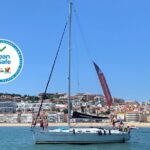
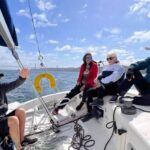
Two hours on the Tagus beats another walking loop. I love how this sail turns Lisbon’s landmarks into a moving photo set, with crew-led stories and time to actually enjoy the views. You’ll get close-up shots of the 25th of Abril Bridge and a relaxed small-group vibe that still feels like sightseeing. The one thing to consider is the weather: this experience requires good conditions, and the river can feel chilly on cooler days.
I also like that boarding is straightforward, with a mobile ticket and an easy meeting spot at Doca do Bom Sucesso (gate 3). For $36.04, you’re not just paying for a boat ride. You’re paying for sailing time, insurance/fuel/crew, a welcome drink, and light snacks, plus the kind of local talk that helps you connect what you’re seeing with what it means.
In This Review
- Key things I’d plan around
- Why a Tagus sailing tour is the fast way to see Lisbon
- Getting on board: Bloo Boat Charter at Doca do Bom Sucesso
- What’s included on a 2-hour Lisbon sail (and what that means for value)
- Belem’s riverfront first: Infante Dom Henrique, old artillery, and MAAT’s modern shell
- The Discovery Monument and Infante Dom Henrique (the Navigator)
- The rocky outcrop and the old ship that belonged to the departure era
- Central Tejo and MAAT: industrial Lisbon meets contemporary art
- Jerónimos Monastery from the water: UNESCO vibes without the crowds
- 25th of Abril Bridge: the close-up you actually came for
- Downtown Lisbon from the water: Praça do Comércio, Sé Cathedral, and Alfama’s texture
- Praça do Comércio (Terreiro do Paço)
- Lisbon Cathedral (Church of Santa Maria Maior / Sé)
- Alfama: the oldest Lisbon neighborhood, seen in context
- Cristo Rei: the south-bank giant that frames Lisbon in one statue
- Crew style and sailing comfort: why people keep recommending this
- Who should book this Lisbon sailing tour
- Should you book? My honest take
- FAQ
- How long is the sailing tour?
- Where does the tour start?
- Is the tour offered in English?
- What’s the price per person?
- What’s included in the ticket?
- Are meals included?
- Is there a restroom onboard?
- How many people are on the tour?
- What happens if the weather is bad?
- Can I cancel for a refund?
Key things I’d plan around
- Small-group sailing (max 12, often much less): it feels personal, even if you’re traveling with kids or going solo.
- Belem departures with big river viewpoints: think MAAT, the Jerónimos area, and the Discovery monuments from the water.
- The 25th of Abril Bridge is a photo target: you’ll get the framing you usually only get from a great lookout.
- Included drinks and light bites: welcome drink, peanuts/cashews/fried corn, and water on board.
- Crew who guide without rushing you: you’ll get commentary and still have time to look, take photos, and ask questions.
- A short, efficient 2 hours: enough time to see a lot without eating your whole day.
Why a Tagus sailing tour is the fast way to see Lisbon
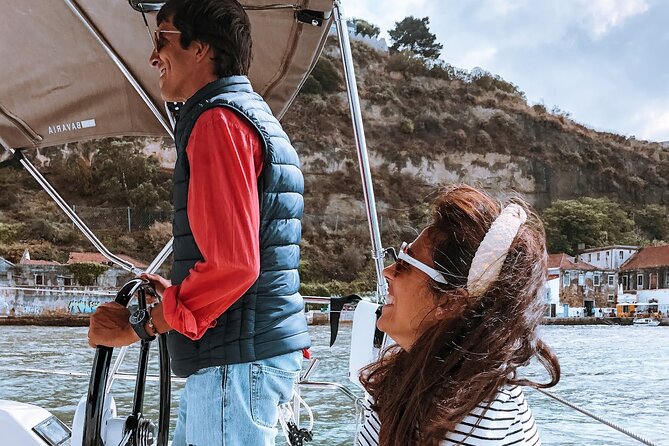
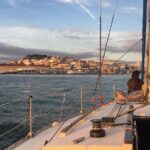
Lisbon looks best from the hills, sure. But it also hits differently from the water. On this sail, the Tagus River becomes your “main street,” and landmarks slide past in the right order for understanding the city.
Instead of climbing stairs just to reach one viewpoint, you’re doing the opposite: letting the city come to you. That’s why I think this is such a smart first-day (or near-first-day) activity. You’ll start to recognize the shapes: the bridge, the cathedral silhouette, the Belem waterfront, and the big downtown square as they connect across the river.
It’s also a good way to slow down. The boat moves at a human pace. And when the crew sets sail partway through (many departures do), you get that real sailing feel instead of just “sitting on a boat.”
You can also read our reviews of more boat tours in Lisbon



Getting on board: Bloo Boat Charter at Doca do Bom Sucesso

The meeting point is Bloo Boat Charter at Doca do Bom Sucesso, gate 3 (1400-038 Lisboa). If you’re using public transport, this is a practical spot rather than a maze of transfers.
You’ll use a mobile ticket, and service animals are allowed. Confirmation happens at booking, so plan on having your details ready on your phone. And because it’s a small vessel operation, showing up a little early matters. River tours run on tight timelines.
What to bring is simple:
- A light layer or jacket, especially if you go when the air is cooler.
- Sunglasses and a camera with a working zoom (the bridge and Cristo Rei are easier when you can frame quickly).
- If you’re sensitive to wind, bring something to cover up a bit. The breeze is part of the experience, but you control your comfort.
What’s included on a 2-hour Lisbon sail (and what that means for value)
This tour is priced at $36.04 per person and lasts about 2 hours. The value is that most of the “hard costs” are already baked in: crew, fuel, insurance, all fees/taxes, plus onboard hospitality.
Included on board:
- A welcome drink
- Light snacks (peanuts, cashews, fried corn)
- Insurance and fuel
- Crew (they speak Portuguese, English, French, and Spanish)
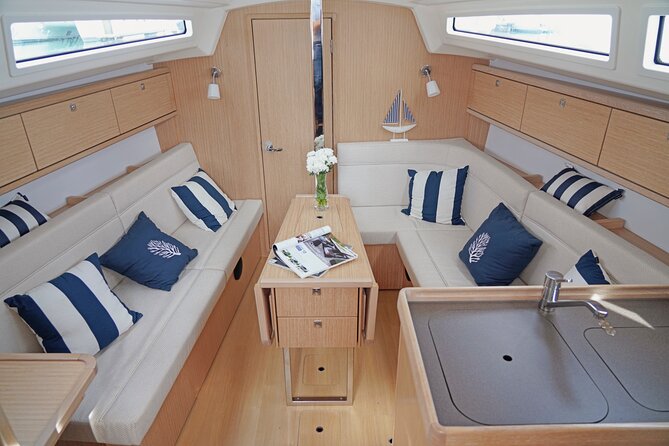
- The tour includes a restroom onboard, and there’s space below deck for bags (handy if you’re traveling with more than just a daypack)
No meals are included, so don’t plan to replace lunch or dinner with this. Think of it as your scenic “in-between,” the kind of outing that makes the rest of your Lisbon day feel easier.
You’ll also notice something in the reviews that matches the practical reality: the crew tends to run a calm ship. People talk, ask questions, and then the views win. One solo rider described it as relaxed and entertaining, which is exactly what I’d want in a short tour.
Belem’s riverfront first: Infante Dom Henrique, old artillery, and MAAT’s modern shell
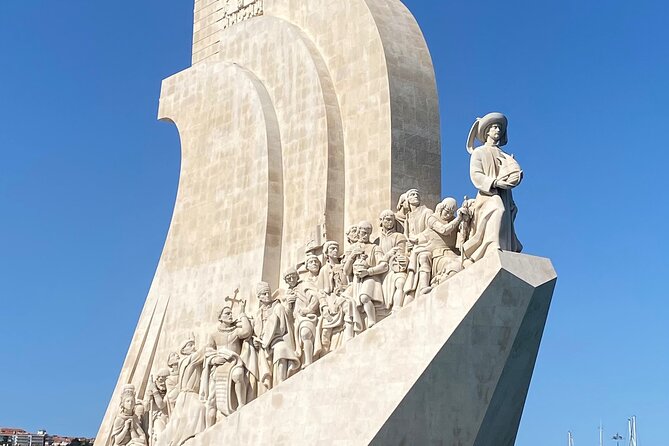
The route starts in the Belem area, and right away you’re treated to a story-rich stretch of river.
The Discovery Monument and Infante Dom Henrique (the Navigator)
One early stop is a National Monument tied to Portugal’s age of discoveries. It centers on Infante Dom Henrique (the Navigator) holding a model of a caravel. Around the ramps, there are 32 figures representing the history of the discoveries, with sculptural work credited to Leopoldo de Almeida.
What you should look for from the water: the way the monument sits like a gateway to the river. It’s not just “a statue you pass.” It’s a landmark that helps explain why Lisbon became a launching point for exploration.
You can also read our reviews of more sailing experiences in Lisbon






The rocky outcrop and the old ship that belonged to the departure era
Another stop area sits on a rocky outcrop opposite Belém’s old beach. This location is described as replacing an older artillery ship anchored where fleets departed for the Indies. The work was overseen by Diogo Boitaca, who was also directing advanced works on the neighboring Jerónimos Monastery.
Even if you don’t go full nerd-mode on Portuguese maritime history, this is still a meaningful contrast: you’re seeing modern Lisbon while the river still carries the “departure” memory.
Central Tejo and MAAT: industrial Lisbon meets contemporary art
Next comes Central Tejo, also called the old thermoelectric power station. Built between 1908 and 1951, it’s one of Portugal’s most beautiful examples of early 20th-century industrial architecture. Then you get MAAT, a contemporary art museum built with two main poles: the old Central Tejo and the New Building.
From the river, this combo is especially satisfying because it shows how Lisbon reuses what it already built. You see the industrial bones, then the museum’s modern form, and it all makes sense as one riverside district instead of scattered points.
Jerónimos Monastery from the water: UNESCO vibes without the crowds

The Jerónimos Monastery (also known as the Monastery of Santa Maria de Belém) is one of Lisbon’s big-name sites. It was built in the late 15th century by King Manuel I. It became a National Monument in 1907, and it was recognized by UNESCO in 1983 along with Belém Tower.
From a boat, the monastery has a different feel. You’re not fighting for a perfect angle among tour groups. You’re watching it as part of the riverfront landscape, which helps you understand why this stretch of Lisbon matters.
One practical note: the sail is only about two hours, so don’t expect long, detailed stops on land. Treat Jerónimos from the water as your visual “hook.” If you want to go inside, plan that as a separate visit afterward.
25th of Abril Bridge: the close-up you actually came for
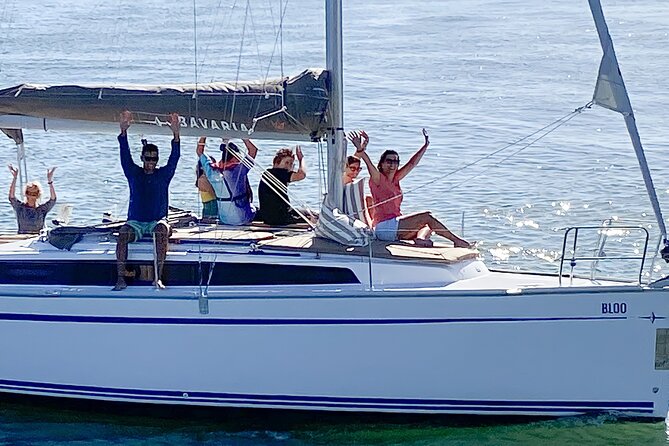
Then the big moment arrives: the 25 de Abril Bridge.
It’s a road-rail suspension bridge over the Tagus that connects Lisbon’s north bank to Almada’s south bank. Up until 1974 it was called Ponte Salazar. The current name refers to the 25 April 1974 revolution. Construction started 5 November 1962 and it opened 6 August 1966.
This is where the sail earns its reputation. From the deck, the bridge fills your frame in a way you don’t get from most walking viewpoints. The crew also tends to position you for the best sightlines so you can take photos fast before the boat moves on.
If you care about photography, I’d suggest:
- Stay on deck when the bridge is near.
- Move to the side that gives you depth (you want bridge lines plus river space, not a flat front-on shot).
- Take a wide shot first, then a tighter one.
Many riders specifically call out the bridge and the Christ statue as standout photo moments, and that matches what the landmark list signals.
Downtown Lisbon from the water: Praça do Comércio, Sé Cathedral, and Alfama’s texture
After the bridge area, the sail continues into the Lisbon side of the story. You start seeing the city’s “center of gravity” from the river.
Praça do Comércio (Terreiro do Paço)
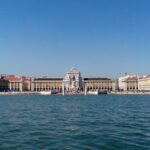
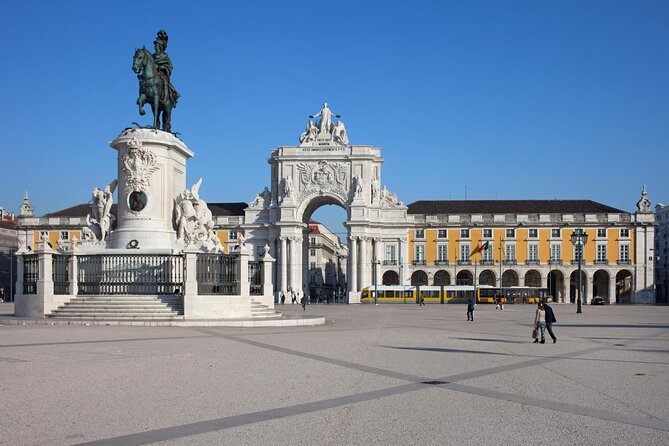
You’ll pass or view Praça do Comércio, still commonly referred to as Terreiro do Paço. It’s Lisbon’s big downtown square, once the palace entrance area for Portuguese kings, and today it’s partially occupied by government departments.
The square is famous for its scale, but what matters most for you from the boat is how the river-side steps connect to the urban core. On the marble steps of Cais das Colunas, heads of state once disembarked, and the square served as the ceremonial entry.
Look for the equestrian statue of D. José, erected in 1775 by Joaquim Machado de Castro. And if you’re thinking ahead to walking plans, the Arco Triunfal da Rua Augusta on the north side is your downtown marker.
Lisbon Cathedral (Church of Santa Maria Maior / Sé)
Next is the Cathedral of Lisbon, also known as Santa Maria Maior and Sé. Construction began in the second half of the 12th century after Lisbon was taken from the Moors under D. Afonso Henriques. It’s a mix of architectural styles, and it’s been a National Monument since 1910.
From the river, this cathedral is easier to read as a shape than as a set of details. It’s perfect for getting your bearings fast.
Alfama: the oldest Lisbon neighborhood, seen in context
Then you get a sense of Alfama, Lisbon’s oldest and one of its most typical neighborhoods. The name traces back to Arabic al-hamma, meaning source of warm waters. Alfama is known for restaurants and fado houses, and it comes alive during Santos Populares, especially Santo António night (12–13 June).
From the water, you’re not trying to “tour Alfama,” but you’ll understand why it’s such a magnetic area to wander afterward. It’s the kind of neighborhood that makes the city feel like itself.
Cristo Rei: the south-bank giant that frames Lisbon in one statue
As the sail goes on, you get a view toward Cristo Rei, the National Sanctuary of the Sacred Heart of Jesus.
Cristo Rei sits at 133 meters above the Tagus and includes a portico designed by António Lino, standing 75 meters high. On top is the statue of the Holy Redeemer with open arms facing Lisbon. The statue is 28 meters tall, sculpted by Francisco Franco de Sousa.
This stop is special because it flips your perspective. From Belem and downtown, Lisbon feels like it’s pulling you in. Cristo Rei makes it feel like you’re looking at a city from a distance that still feels personal.
It also gives you a strong “last photo” target, the kind that works whether you’re traveling with kids, going as a couple, or documenting your trip solo.
Crew style and sailing comfort: why people keep recommending this
The most praised aspect in the reviews is the vibe: friendly, attentive crew who mix safety with stories. Names that come up repeatedly include Paolo, Lorenzo, Gabriel, João, Pedro, Titouan, Issac, Daniela, Ricardo, Tomás, and Paulo (the captain and mate roles appear across different departures).
Here’s what that means for you: you’re not stuck with a one-size-fits-all script. People talk about guides sharing history, answering questions patiently, and still giving space for just enjoying the river.
Comfort-wise, riders mention:
- Smooth sailing
- Time to enjoy scenery rather than rushing through “points”
- Snacks and drinks that take the edge off wind and sun
- A bathroom onboard
- Blankets for cooler weather on some departures
Two hours is also the sweet spot. You get a full “river memory,” but you’re not stuck commuting your whole afternoon.
Who should book this Lisbon sailing tour
I think this one fits best if you:
- Want Lisbon landmarks without climbing hills all day
- Like photography from a moving viewpoint (bridge and Cristo Rei are big targets)
- Prefer small-group tours with room to ask questions
- Are traveling with kids or teens who might not want a long walking day
- Are first-time visitors who need a fast orientation
It might be less ideal if you’re expecting a long, on-land museum-style experience, or if you know you struggle with cool wind. Since the tour requires good weather, also be ready to adjust if conditions are rough.
Should you book? My honest take
Yes, book it if you want a calm, scenic way to see Lisbon’s big landmarks in one short stretch. For $36.04, you’re not overpaying for “just a boat.” You’re paying for sailing time plus onboard snacks/drinks and real guiding.
I’d especially recommend it as a first-day activity, because it helps you plan the rest of your itinerary with better context. You’ll recognize the bridge and the cathedral later when you’re wandering on foot.
But if you’re set on spending most of your time on land, or you hate the idea of being at the mercy of weather, you may want to pair this with other indoor plans. The sail is the highlight, and it works best when the Tagus is playing nicely.
FAQ
How long is the sailing tour?
It runs for about 2 hours.
Where does the tour start?
The meeting point is Bloo Boat Charter at Doca do Bom Sucesso, gate 3, 1400-038 Lisboa.
Is the tour offered in English?
Yes. It is offered in English.
What’s the price per person?
The listed price is $36.04 per person.
What’s included in the ticket?
The ticket includes all fees and taxes, insurance, crew, fuel, a welcome drink, and light snacks (peanuts, cashews, fried corn).
Are meals included?
No meals are included.
Is there a restroom onboard?
Yes, a toilet is available onboard.
How many people are on the tour?
There is a maximum of 12 travelers. Some departures can be very small.
What happens if the weather is bad?
This experience requires good weather. If it’s canceled due to poor weather, you’ll be offered a different date or a full refund.
Can I cancel for a refund?
Yes. Free cancellation is available up to 24 hours in advance for a full refund.