REVIEW · ISTANBUL
Afternoon Bosphorus Cruise Luxury Yacht with Professional Guide
Book on Viator →Operated by Yacht Cruises: Bosphorus · Bookable on Viator
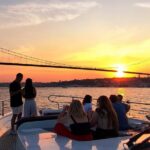
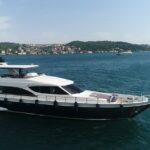
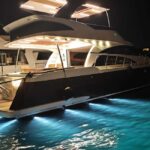
The Bosphorus moves like a living map. On this 2-hour luxury yacht cruise, you glide past palaces, fortresses, and skyline icons while a professional guide ties the scenery to what you’re looking at.
I love the English guide—Celil’s narration is a big part of why this tour feels so worth it. I also like the included onboard snacks and drinks, especially the homemade lemonade with fresh mint plus fruit, cookies, and baklava.
One possible drawback: this is still open-water cruising, so if you get seasick or have vertigo, you’ll want to think twice.
In This Review
- Key highlights before you go
- What you’re really buying: 2 hours of Bosphorus prime viewing
- Getting started at the pier near Beyoğlu (and why that matters)
- Your Bosphorus “intro lesson” as the views roll in
- Why this matters for first-timers
- Dolmabahçe Palace: imperial scale right at the water’s edge
- What to watch for from the boat
- A small consideration
- Çırağan Palace: marble luxury and a grim chapter
- Why this stop works even without a ticket inside
- Ortaköy: cafés, market energy, and the famous bridge views
- The feet of the Bosphorus Bridge: a modern landmark with old-water drama
- Rumeli Hisarı (Rumeli Fortress): built fast to control the narrowest point
- What might surprise you
- Anadolu Hisarı: the fortress that still feels like a ruin and museum at once
- Küçüksu Pavilion: Ottoman summer retreat by the shoreline
- Beylerbeyi Palace: a 19th-century summer palace under the bridge
- Maiden’s Tower: a tiny island with a big legend
- Why this works during a cruise
- Galata Bridge and Galata Tower: daily life on water and above the city
- Onboard comfort: what’s included and why it helps
- The small practical win
- Who this cruise is best for
- Should you book the Afternoon Bosphorus Luxury Yacht Cruise?
- FAQ
- How long is the Bosphorus yacht cruise?
- What time does the cruise start?
- What’s included onboard?
- Are alcoholic beverages included?
- What language is the tour offered in?
- Where do I meet, and where does it end?
- Is it suitable for people who get seasick or have vertigo?
- What’s the cancellation policy?
Key highlights before you go
- Celil’s clear, human storytelling makes the landmarks easier to recognize and remember.
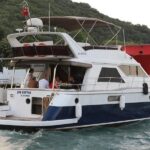
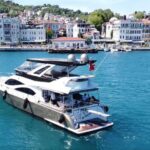
- Luxury-yacht comfort for 2 hours, with a restroom on board and no long walking stretches.
- Free drinks plus dessert-level treats: lemonade, tea/coffee, and a fruit plate with cookies and baklava.
- Bosphorus-style “both continents” views as you look toward both the European and Asian shores.
- Big-ticket sights from the water: Ortaköy, palaces, Rumeli Hisarı, Anadolu Hisarı, Maiden’s Tower, and more.
What you’re really buying: 2 hours of Bosphorus prime viewing
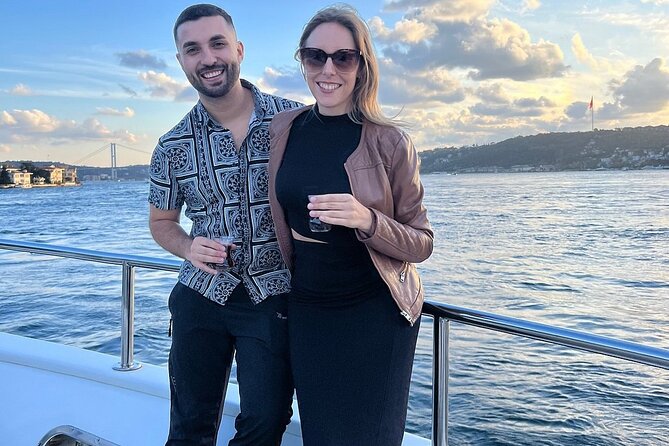
At first glance, this sounds like a simple sightseeing cruise. In practice, it’s a smart Istanbul shortcut: in about 2 hours you get a guided pass of the Bosphorus’s biggest skyline players, without the fatigue of hopping between neighborhoods. You’ll be on the water, so the city’s shapes make more sense fast.
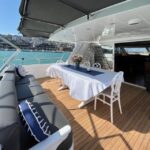
The price is $25.74 per person, and the value comes from the mix of comfort and inclusions. This isn’t just a boat ride where you watch from a corner. You get a professional guide, a restroom on board, and a full snack-and-drink setup: homemade lemonade with fresh mint, water, tea, and coffee. Then there’s a fresh season fruits plate plus cookies and baklava served during the cruise.
There are two practical notes. First, the tour includes no alcohol, so don’t plan on beer or wine. Second, seasickness can be a dealbreaker for some people, and the operator specifically says it’s not recommended for vertigo and seasickness.
You can also read our reviews of more boat tours in Istanbul

Getting started at the pier near Beyoğlu (and why that matters)

The meeting point is Türkiye Petrolleri Ömer Avni, Meclis-i Mebusan Cd. No:34 in Beyoğlu (34427). The activity starts at 1:00 pm and ends back at the meeting point. If you’re staying around central Istanbul, the good news is that it’s listed as near public transportation.
Because you’re cruising for only about 2 hours, your timing matters more than usual. I’d aim to arrive a bit early so you’re not rushing onto the boat right when the narration begins. Bring layers too: afternoons can be warm inland but breezier near the water.
Your Bosphorus “intro lesson” as the views roll in
The cruise’s backbone is the Bosphorus itself. This strait separates Europe and Asia and links the Sea of Marmara with the Black Sea. It’s about 30 kilometers long, and it’s not just scenic—it’s an engineered connection with real depth, variable width, and shifting currents.
As you move along, you’ll get the kind of details that make the shoreline make sense. For example: the water has currents that run in opposite directions depending on depth. On the surface, current flows from the Black Sea toward the Marmara, while underneath, it flows the other way. It’s one of those small facts that turns a pretty scene into something you can actually picture.
Why this matters for first-timers
If you’re new to Istanbul, “where things are” is often confusing. A guided water route clears that up quickly because you’re seeing the city’s two coasts facing each other.
Dolmabahçe Palace: imperial scale right at the water’s edge
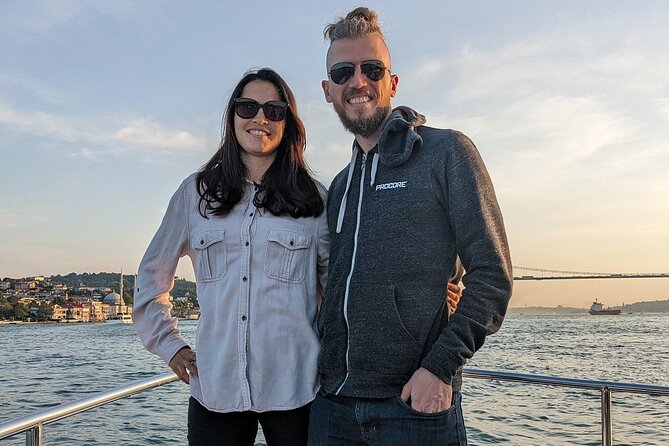
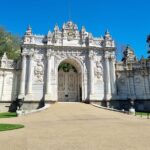
Next up is Dolmabahçe Palace, located in Beşiktaş on the shore area between Kabataş and Beşiktaş, with the Bosphorus right beside it. The setting is part of the attraction: it sits opposite Üsküdar and Kuzguncuk, so from the yacht you can frame it cleanly against the water.
The palace is Ottoman in spirit and massive in footprint, set on an area of about 250,000 m². Even if you don’t go inside, the sight from the Bosphorus shows you why sultans wanted to live with ships and sea views close at hand.
You can also read our reviews of more guided tours in Istanbul
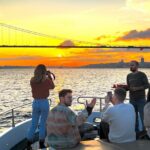

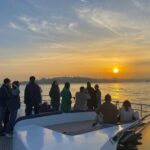

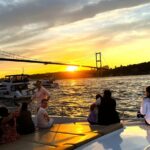
What to watch for from the boat
Look for how the palace’s position handles the coastline. A lot of waterfront Istanbul buildings face the water, but Dolmabahçe feels more like it commands it.
A small consideration
Palaces are big. From a moving boat, you won’t get museum-level details, so if you crave close architectural study, pair this cruise with at least one palace interior visit on a different day.
Çırağan Palace: marble luxury and a grim chapter
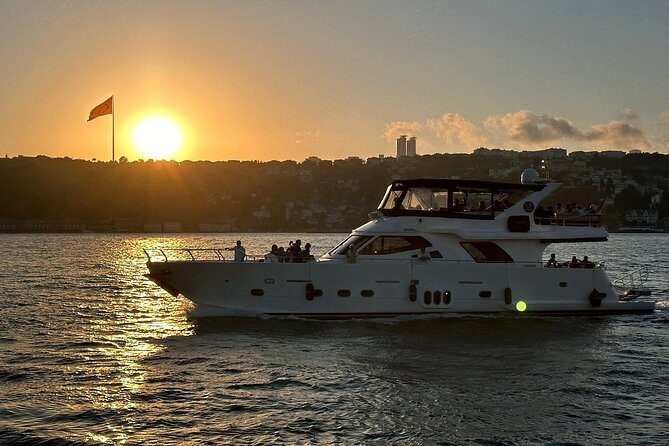
You’ll also pass by Çırağan Palace. This one has drama baked into its story. It was commissioned by Sultan Abdülaziz and designed by Sarkis Balyan. The site originally held a wooden summer palace built around 1800, but the construction process replaced that setting.
Çırağan was completed in 1871 and is made of marble. It spans about 80,000 m², which tells you the scale right away.
Then comes the human part: after Abdülaziz was deposed, he was imprisoned here with his family. Later, after Murat V was deposed, he was also held here for many years with his family.
Why this stop works even without a ticket inside
Cruises are great when you want context. Even from outside views, the guide’s narration about who lived here and why adds weight to the architecture.
Ortaköy: cafés, market energy, and the famous bridge views
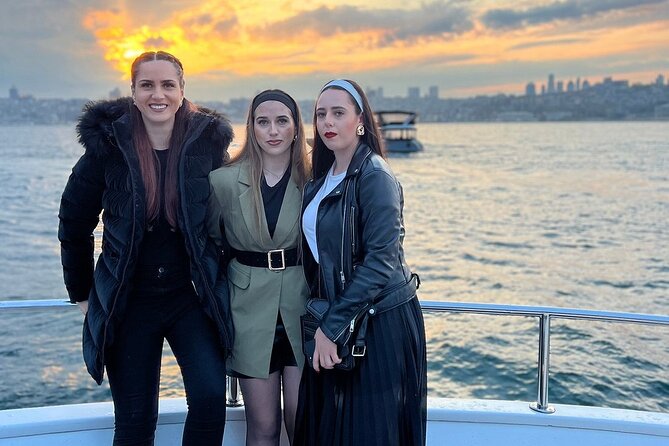
As you continue, the yacht’s route brings you into the atmosphere of Ortaköy on the European side (Beşiktaş district). Ortaköy’s waterfront slopes toward the sea, and it has an always-on feel thanks to the bazaar area.
From the boat, you’re not shopping—you’re observing. Still, Ortaköy stands out because it blends small stalls, cafes, and souvenir browsing with big-photo scenery. It’s especially lively through the day, and the area starts to really move after about 10:00 am (according to how the neighborhood market operates).
A big reason you’ll remember this stretch is the way it sets you up for one of Istanbul’s best skyline compositions: the nearby bridge zone.
The feet of the Bosphorus Bridge: a modern landmark with old-water drama
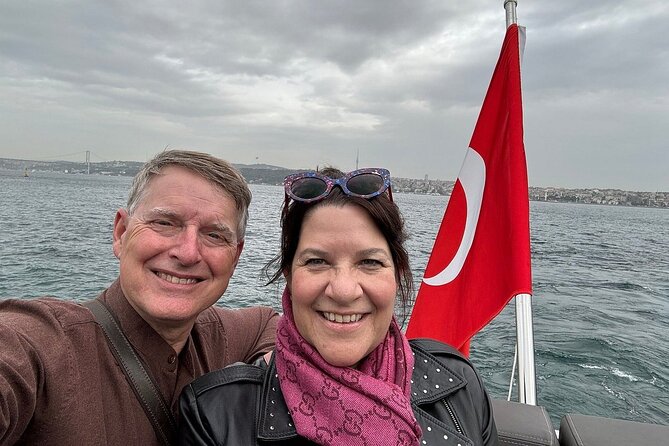
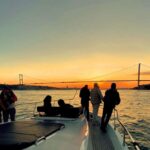
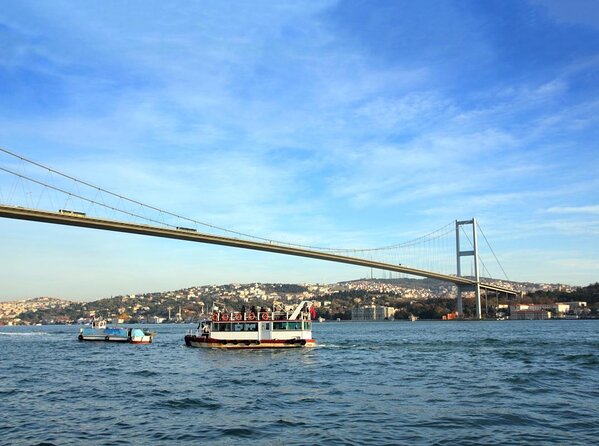
You’ll see the Bosphorus Bridge from the Ortaköy (European) and Beylerbeyi (Asian) sides. This matters because it’s not just a bridge; it’s a symbol of how the city physically connects the two halves of itself.
Key facts to keep in mind:
- It was the first bridge built on the Bosphorus.
- Construction started in 1970 and it opened on 29 October 1973, marking the 50th anniversary of the Republic proclamation.
- It’s a suspension bridge and remains a highly active crossing point, with constant movement.
From the yacht, the bridge often looks like it’s hovering above the water, and that’s when you get that instant Istanbul feeling: old waterways, new engineering, and the city stacked along both shores.
Rumeli Hisarı (Rumeli Fortress): built fast to control the narrowest point
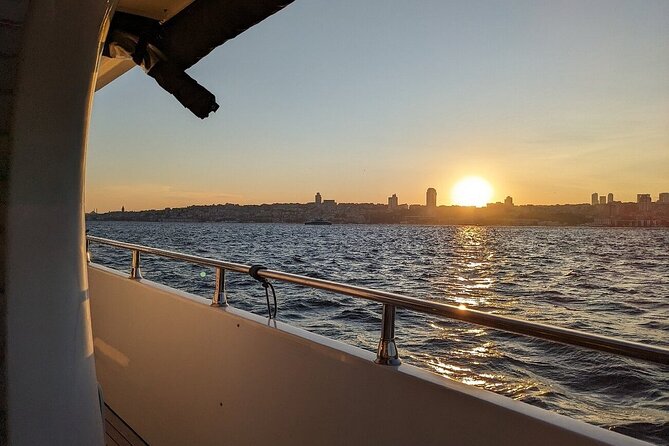
Next is Rumeli Hisarı, also called Rumeli Fortress, in Sariyer on the European side. The placement is strategic: it sits directly across from Anadolu Hisarı at one of the Bosphorus’s narrowest points.
This fort has a dramatic speed story. Construction began in 1453 under Sultan Mehmed the Conqueror, and it was completed in only three months. Before the conquest of Istanbul, it was used to protect against naval attacks. After the conquest, it became an inspection point for maritime traffic.
Today, it’s known for summer concerts and serves as an open-air theater and museum. Even if you’re not entering, the fortress mass from the water gives you a sense of how command over this strait was treated like a life-and-death priority.
What might surprise you
You’ll see restoration changes over time, including that the inner area once held small wooden houses, and those were removed during restoration work in 1953.
Anadolu Hisarı: the fortress that still feels like a ruin and museum at once
On the Asian side, you’ll get a view of Anadolu Hisarı (Anatolian Fortress) in Beykoz. It was built in 1395 by Bayezid I. Like its counterpart, it was designed for control of the Bosphorus at a narrow choke point.
After the conquest, it lost much of its strategic importance and became a military hospital. Over time, the surrounding area became settled, so today you’ll notice waterfront houses and older mansions spread among the castle ruins.
Restoration took place between 1991 and 1993, and it was converted into a museum. Important practical note: it’s not open to the public, and you can only visit the outer walls, plus the road passes right through the area. From a boat, this stop becomes about the exterior presence—how it sits against the water and how close you feel to it.
Küçüksu Pavilion: Ottoman summer retreat by the shoreline
You’ll also see the Küçüksu Pavilion museum, tied to the way Ottoman emperors used the Bosphorus as a summer playground. The pavilion functioned as a summer palace and hunting lodge for multiple emperors.
This stop is different from the forts and palaces because it’s smaller and more about leisure. When you look at the shoreline here, it’s a reminder that the Bosphorus wasn’t only for power and defense. It was also for seasonal escape.
Beylerbeyi Palace: a 19th-century summer palace under the bridge
Another major waterfront landmark is Beylerbeyi Palace. The name is often translated as something like Lord of Lords, and the complex was built in the 1860s on the shores of the Bosphorus. It sits right under the Bosphorus Bridge, which makes it visually fun: you get palace architecture and the bridge’s modern lines in the same view.
Designed by Sarkis Balyan, the palace blends elements from both the East and the West, using styles like Renaissance and Baroque influences. The main building is a two-store structure on a high basement and sits on roughly 2,500 m².
Inside the complex are 6 halls, 24 rooms, plus a hamam and a bathroom. From the yacht, you won’t tour rooms, but you can still appreciate the layout and the garden setting. Don’t miss the lily pond and large garden as visual anchors.
Maiden’s Tower: a tiny island with a big legend
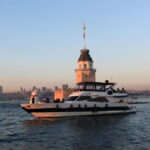
The skyline favorite for many people is Maiden’s Tower (Kız Kulesi). It sits on a tiny island about 200 meters from the shore of Üsküdar. That distance makes it feel separate even when you can see it clearly.
This tower carries legends, and the most popular one goes like this: an oracle prophesied that a sultan’s daughter would die from a snake bite on her 18th birthday. The sultan had the tower built so she could live in secrecy and protection. On her 18th birthday, she’s given a basket of fruit, and a snake is inside, leading to the tragedy.
Why this works during a cruise
From the water, Maiden’s Tower looks like a story turned into architecture. The guide’s version of the legend makes the tower feel personal, not just postcard-perfect.
Galata Bridge and Galata Tower: daily life on water and above the city
As the cruise continues toward the Golden Horn side, you’ll see Galata Bridge (Galata Köprüsü) spanning two sides of the waterway. The bridge’s story starts in 1845, and it has been rebuilt and changed over the years. A fire in 1992 damaged it, and a new bridge was built afterward. The beloved old bridge was moved to Halic.
This is also one of those Istanbul places where the city feels like it’s actively doing things. Under the bridge you can see restaurants, cafes, and hookah lounges. Above it, there’s tramway and heavy pedestrian traffic. From the yacht, it’s a strong picture of everyday Istanbul rather than a single monument.
Close by is Galata Tower, built by Genoese in 1348. It rises to 66.90 meters and was the tallest building in the city when it opened. Over the Ottoman era, it served roles like a fire observatory and even a jail.
One standout tale: in 1632, Hezarfen Ahmet Çelebi famously glided from the top of the tower across the Bosphorus to Üsküdar with self-constructed wings. Even if you’re not into aviation stories, the idea adds a human scale to what could be only stone.
The tower’s roof was destroyed in a storm in 1875 and wasn’t restored during the Ottoman era. The conical cap was restored in the 1960s, and the interior was changed from wood to a concrete structure. Today, it’s open to the public, with a restaurant and café on the upper floor.
Onboard comfort: what’s included and why it helps
This cruise is built for comfort without overcomplicating your day.
You’ll have:
- Restroom on board
- Complimentary drinks: homemade lemonade with fresh mint, water, tea, coffee
- A fresh season fruits plate
- Cookies and baklava served during the experience
- A guide in English
- Maximum group size of 30 travelers
What you won’t have:
- Alcoholic beverages (so keep that in mind)
The small practical win
Because snacks and drinks are included, you’re not hunting for cash-only food or quick bites while everyone else has already settled into the views. It’s especially helpful on a short 2-hour timeline.
Who this cruise is best for
This is a great pick if:
- You want Bosphorus highlights without lots of walking
- You like guided context (not just photos)
- You’re short on time but still want to see big-name sights across both shores
- You appreciate a well-run group experience, especially with a guide like Celil doing the heavy lifting on explanations
It’s not the best choice if:
- You’re sensitive to motion and get seasick easily
- You have vertigo concerns
- You want interior-only palace time (this is primarily about passing views and narration)
Should you book the Afternoon Bosphorus Luxury Yacht Cruise?
If you’re trying to choose one Bosphorus outing that mixes comfort, big landmarks, and real guidance, this is a strong contender. The value is the combination: English narration, onboard treats, and a tight 2-hour format that still hits major sights like Dolmabahçe, Ortaköy, Rumeli and Anadolu Hisarı, Beylerbeyi, Maiden’s Tower, Galata Bridge, and Galata Tower.
My rule of thumb: book it if you want the Bosphorus to feel understandable after just a few stops. Skip it only if motion is a serious issue for you. Otherwise, you’ll come away with a clearer map of Istanbul and a lot of memorable shoreline moments.
FAQ
How long is the Bosphorus yacht cruise?
It’s listed as approximately 2 hours.
What time does the cruise start?
The start time is 1:00 pm.
What’s included onboard?
The cruise includes a 2-hour luxury yacht ride, a restroom on board, complimentary drinks (homemade lemonade with fresh mint, water, tea, and coffee), and a fresh season fruits plate plus cookies and baklava served aboard.
Are alcoholic beverages included?
No. Alcoholic beverages are not included.
What language is the tour offered in?
The tour is offered in English.
Where do I meet, and where does it end?
Meet at Türkiye Petrolleri Ömer Avni, Meclis-i Mebusan Cd. No:34, 34427 Beyoğlu/İstanbul. The activity ends back at the same meeting point.
Is it suitable for people who get seasick or have vertigo?
It is not recommended for travelers with vertigo and seasickness.
What’s the cancellation policy?
Free cancellation is available up to 24 hours in advance for a full refund. It also depends on good weather, and if it’s canceled due to poor weather, you’ll be offered a different date or a full refund.