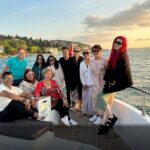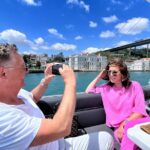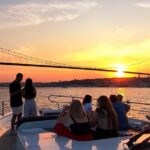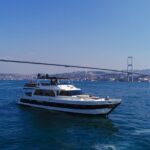
The Bosphorus from a luxury yacht is a win. This guided afternoon sail strings together the Europe–Asia divide with palace-and-bridge views, all wrapped in easy going pacing. I especially like the small group size (up to 30) and the fact that you get professional guide commentary in English while staying comfortable on the water. A single consideration: it’s not a good match if you get seasick or have vertigo, since you’ll be on a boat for the full time.
I love that the experience is built for real time in the city without turning your day into a marathon. You’re also fed well for the price—think tea, lemonade, and Turkish snacks—so you can enjoy the ride instead of hunting for food halfway through. If museums or specific stops are closed on your day, the operator may swap in an alternative, so keep your schedule flexible.
Key highlights you’ll care about
- Up to 30 people means more attention from the guide and less crowding on deck
- English-speaking licensed guide helps you connect landmarks to what you’re seeing
- Ottoman waterfront sights from the water: Dolmabahçe, Çırağan, Beylerbeyi, and more
- Classic photo beats around the Bosphorus Bridge, Fatih Sultan Mehmet Bridge, and the Maiden’s Tower skyline
- Included Turkish snacks and drinks keep the 2 hours pleasant and self-contained
- Weather-dependent plan means you may be offered a different date or full refund if conditions are poor
In This Review
- Why a 2-hour Bosphorus cruise with a luxury yacht is great for Istanbul timing
- From the Beyoğlu meeting point to the water: what to expect in the 2 hours
- Cruising the Europe–Asia divide: Bosphorus views and bridge moments
- Dolmabahçe Palace and the Çırağan Palace story from the shoreline
- Ortaköy vibes, the Bosphorus Bridge feet, and Bebek’s smarter pace
- Rumeli Hisarı and Anadolu Hisarı: fortresses at the narrowest point
- Küçüksu Pavilion and Beylerbeyi Palace: Ottoman summers and garden calm
- Galata Tower, Galata Bridge, and the Maiden’s Tower legend skyline
- What’s included on board: tea, lemonade, baklava, and why it matters
- Who should book this Bosphorus luxury yacht cruise?
- Should you book this Bosphorus guided afternoon cruise?
- FAQ
- What is the duration of the Bosphorus guided afternoon cruise?
- How much does the cruise cost?
- Is the tour guided and in English?
- Are snacks and drinks included?
- Is alcohol included?
- Where do I meet, and where does the tour end?
- What time does the cruise start?
- Who might want to avoid this tour?
- Are there date changes if the weather is bad?
Why a 2-hour Bosphorus cruise with a luxury yacht is great for Istanbul timing
Istanbul is big, and the Bosphorus is the spine. This cruise gives you a focused way to experience that spine without committing a whole day to transit and museum lines. The timing also helps: with a 1:00 pm start and about 2 hours on the water, you get prime daylight views for skylines and palaces, then you can still have your evening plan.
What makes it feel like more than a simple boat ride is the way it’s organized around sightlines. The Bosphorus is the international strait separating Asia and Europe, and your route is built to show you that split repeatedly: bridge angles, historic waterfronts, and the narrow points where the city feels most dramatic.
And yes, “luxury yacht” is part of the pitch here—and your comfort matters. Even without getting fancy promises, the included snacks and drinks plus the small group size are the kind of details that change how relaxed you feel.
From the Beyoğlu meeting point to the water: what to expect in the 2 hours
You meet at Türkiye Petrolleri Ömer Avni, Meclis-i Mebusan Cd. No: 34, 34427 Beyoğlu/İstanbul and the tour ends back at that same meeting point. It’s straightforward, and that matters because Istanbul can be a puzzle of neighborhoods, ferry docks, and confusing cross streets.
This is a guided cruise, and that’s the key. A good guide won’t just name buildings—they connect them to the geography. Here, the geography is the Bosphorus itself: roughly 30 kilometers long, connecting the Sea of Marmara with the Black Sea, and with strong surface currents flowing toward the Marmara (and an opposite underwater flow). Even if you don’t feel the current in a dramatic way, it explains why ships and maritime power shaped Istanbul.
The boat time is the main event—about two hours—so you don’t need to pace yourself for long stops, but you do want to pick the right clothes. If you’re sensitive to wind or motion, bring a light layer and expect some deck breeze.
You can also read our reviews of more boat tours in Istanbul
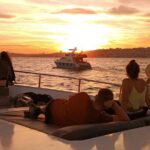
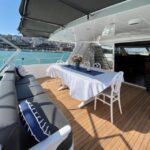
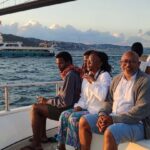
Cruising the Europe–Asia divide: Bosphorus views and bridge moments
The itinerary is basically a greatest-hits reel of the Bosphorus skyline. You’ll be watching the European and Anatolian sides take turns in the frame, and it helps to know what you’re looking for.
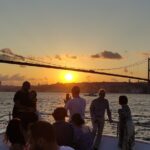
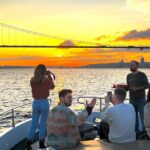
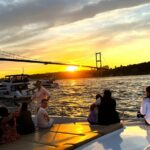
The Bosphorus Bridge is a big early anchor. Located in Ortaköy on the European side and Beylerbeyi on the Anatolian side, it was the first bridge built over the strait and opened in 1973. From the water, this bridge reads like a classic Istanbul symbol: practical transportation, plus a clear “we’re here, both sides of the city matter” feeling.
Then there’s the Fatih Sultan Mehmet Bridge, Istanbul’s second Bosphorus crossing. Construction started in 1986 and it opened in 1988. It’s a major transit link and a skyline landmark. From the cruise, you get the bridge in context—how it sits over the waterway that has long connected seas, empires, and trade routes.
One more geography note that makes the skyline make sense: the Bosphorus is not uniform. The width changes depending on where you are, and that’s why the city can look tight and enclosed in one moment, then open into sweeping views in the next. On this cruise, you see that effect in motion.
Dolmabahçe Palace and the Çırağan Palace story from the shoreline
Two names you’ll hear often in Istanbul—Dolmabahçe and Çırağan—are both tied to the Bosphorus as a favored royal setting. Even when you’re seeing them from the boat (not inside), they still hit because they’re built on the water’s edge.
Dolmabahçe Palace sits on a large waterfront area in Beşiktaş, between Dolmabahçe Street and the Bosphorus. It’s positioned on the European side near the entrance to the strait from the Sea of Marmara, opposite Üsküdar and Kuzguncuk. The context you’ll appreciate is that this area wasn’t always palace-grade. It began as a cove where ships anchored, and over time it became a prime residence for the sultanate. That shift—from maritime utility to political power—explains why the buildings look like they belong to the waterline.
Çırağan Palace follows a darker, more dramatic Ottoman path. Commissioned by Sultan Abdülaziz and completed in 1871, it’s made of marble and spread over a large area. After Abdülaziz was deposed, he was imprisoned here for years with his family. Later, when Murad V was deposed, he too was imprisoned here for long years. The palace also saw a different life as a House of Parliament after the 1908 constitutional period, and it suffered damage in a 1910 fire. Later it reopened as a luxury hotel after restoration in the early 1990s.
Why this matters for you on a cruise: when you can see palaces from the water, you get a stronger sense of why rulers cared about the shoreline. This isn’t abstract Ottoman architecture. It’s architecture built to control movement, signal wealth, and dominate a strategic waterway.
Ortaköy vibes, the Bosphorus Bridge feet, and Bebek’s smarter pace
If you want a neighborhood snapshot without committing to a full day on your feet, this part works well.
Ortaköy is a Beşiktaş district on the European side, built along slopes opening toward the coast. The bazaar area is lively through the day, with souvenir shops, cafés, and restaurants. The practical tip here is timing: the market movement often starts later (around after 10:00 am), so on a 1:00 pm cruise day you’re usually in the active window. Even if you’re not wandering the bazaar yourself, the waterfront energy shows up clearly in how the area looks from the boat.
Ortaköy is also where the feet of the Bosphorus Bridge anchor on the European side, so the photo angles can be excellent: bridge structure, crowds near the water, and the Bosphorus in between.
Then Bebek brings a different mood. It’s a historic neighborhood on the European shore, known for waterside mansions and a more residential feel. The Bosphorus views are the main draw, and Bebek tends to read like a place for a slower stroll later—after your cruise—if you want to keep exploring.
A possible drawback: if you’re hoping for heavy “on foot” time in these neighborhoods, this cruise is still mainly a time-on-the-water experience. It’s best used as a view-and-understand stop, not a replacement for a full neighborhood walk.
Rumeli Hisarı and Anadolu Hisarı: fortresses at the narrowest point
This is the section where the cruise starts to feel like a story of control over maritime traffic.
Rumeli Hisarı (Rumeli Fortress) sits in Sariyer on the European side and was built directly across from Anadolu Hisarı. Construction started in 1453 under Sultan Mehmed the Conqueror and was completed in just three months, placed at the narrowest point of the Bosphorus. That speed and location were about defense: before Istanbul’s conquest, the fortress protected against naval attacks, and after the conquest it became an inspection point for maritime traffic.
Today, the fortress area fills with summer events. Restoration removed older wooden houses during work in 1953, and after restoration it became known for concerts and is used as an open-air theater and museum. From the water, it reads like a strategic landmark first, and an art venue second—which is exactly why it works on a cruise: it’s built for watching and watching ships.
On the opposite side, Anadolu Hisarı (Anatolian Fortress) is in Beykoz at the Bosphorus narrowest point. Built in 1395 by Bayezid I, it includes a citadel and exterior walls. After the conquest, its strategic importance faded and it was converted into a military hospital. Restoration in 1991–1993 turned it into a museum, but it’s not open to the public in full; today you can only visit the outer walls and a road passes through the area.
Why I think this pair is valuable: the Bosphorus can look like a pretty skyline on postcards, but the fortresses remind you why people fought over this water. It’s the same strait that carries currents and connects seas—so the “pretty” and the “power” are never far apart.
You can also read our reviews of more guided tours in Istanbul

Küçüksu Pavilion and Beylerbeyi Palace: Ottoman summers and garden calm
The cruise also includes palace and pavilion sights that feel more seasonal than fortress-like.
Küçüksu Pavilion is described as a museum and a former summer palace and hunting lodge used by Ottoman emperors. The point for you isn’t only that it’s historic. It’s that the Bosphorus wasn’t only defense and politics—it was also lifestyle, leisure, and retreats away from palace life.
Then there’s Beylerbeyi Palace, on the shores of the Bosphorus and located right under the Bosphorus Bridge. Built in the 1860s and designed by Sarkis Balyan, it mixes elements of Renaissance and Baroque with stylistic influences from both East and West. The palace layout matters visually: it’s two-storey with a stone main building on a high basement, and it includes different sides organized for imperial functions. The complex also has a lily pond and large gardens, which is a detail you’ll appreciate even when you’re seeing it from the waterfront angle—those water features echo the Bosphorus setting.
A small caution: because this is a cruise experience, your time with gardens or interior access may not be the same as a full museum visit. The value here is that you get the setting and architectural cues without turning your day into a long ticketing and walking routine.
Galata Tower, Galata Bridge, and the Maiden’s Tower legend skyline
If you want Istanbul’s silhouette in one tidy mental map, this cruise helps you build it.
Galata Tower is a nine-story tower built by Genoese in 1348, reaching 66.90 meters. It was used in Ottoman times as a fire observatory and even as a jail. One famous story tied to it is Hezarfen Ahmet Çelebi’s flight across the Bosphorus to Üsküdar with self-constructed wings in 1632. You’ll also hear about the tower’s damage during a storm in 1875 and how its conic roof was restored later with a concrete interior replacement. Today, it’s open to the public and has a restaurant and café on the upper floor—so even if you don’t go up, it’s one of the easiest landmarks to recognize on Istanbul skylines.
Then you’ll see the Galata Bridge over the Golden Horn. That bridge has a history dating back to 1845 and has changed through time. It was damaged by fire in 1992, and a new bridge was built afterward. The old beloved bridge was moved to Haliç. On the cruise, Galata Bridge matters because it anchors everyday life: the tramway and pedestrian traffic above, and the food-and-drink culture below with restaurants, cafés, and hookah lounges.
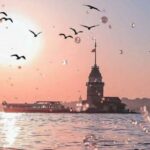
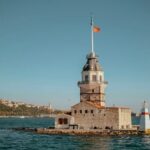
Finally, the cruise experience highlights the Maiden’s Tower (Kız Kulesi)—on a tiny island about 200 meters from the shore of Üsküdar. It’s famous for legends, including the oracle about a sultan’s daughter dying from a snakebite on her 18th birthday. The tower became associated with protection and fate, which is exactly the kind of story that makes a skyline feature feel personal instead of generic.
What’s included on board: tea, lemonade, baklava, and why it matters
This tour is built around comfort details that make a short outing feel complete.
Included snacks and drinks list is impressive for the price point:
- cookies and baklava
- Turkish tea, lemonade
- fruit plates and water
That food-and-drink package does two things for you. First, it keeps the 2 hours friction-free. You’re not scrambling for cash, lines, or last-minute refueling. Second, it adds a very Istanbul touch: tea is the default mood on many local outings, and baklava is a high-connection snack in Turkish food culture.
One key boundary: alcohol isn’t included, and the minimum drinking age is 18+. So if you’re expecting a party vibe with cocktails, you’ll likely be disappointed. If you want views with a calm, guided tone, it fits much better.
Who should book this Bosphorus luxury yacht cruise?
This is a great fit if:
- you want an easy afternoon with two continents, bridges, and Ottoman landmarks
- you like guided explanations that help you recognize what you’re seeing
- you’re trying to balance “big sights” with relaxation
- you like small-group experiences (up to 30)
It’s not the best fit if:
- you have vertigo
- you’re prone to seasickness
- you’re looking for a long list of museum-time hours or deep interior access
Also, the tour is in English and uses mobile tickets, which is handy if you prefer simple phone-based check-in.
Should you book this Bosphorus guided afternoon cruise?
If your goal is to get oriented fast and see Istanbul’s most iconic water views in one go, I think this is a smart booking. The value comes from the combination: a licensed guide, a tight 2-hour format, a small group, and included snacks that turn the cruise into a complete outing rather than just transportation between sights.
If you’re the type who hates boat motion, plan carefully. The itinerary is view-heavy and takes place on water for the full duration, so your comfort is the deciding factor. Otherwise, it’s one of those bookings that makes Istanbul feel tangible right away—Europe and Asia in the same frame, bridges overhead, palaces along the shoreline, and enough context to make the skyline mean something.
FAQ
What is the duration of the Bosphorus guided afternoon cruise?
It runs for about 2 hours.
How much does the cruise cost?
The price is $35.39 per person.
Is the tour guided and in English?
Yes. It includes a professional licensed tour guide, and the tour is offered in English.
Are snacks and drinks included?
Yes. The tour includes snacks such as cookies and baklava, Turkish tea, lemonade, fruit plates, and water.
Is alcohol included?
No. Alcoholic beverages are not included, and the minimum drinking age is 18 years and above.
Where do I meet, and where does the tour end?
You start at Türkiye Petrolleri Ömer Avni, Meclis-i Mebusan Cd. No: 34, 34427 Beyoğlu/İstanbul, Türkiye, and the activity ends back at the meeting point.
What time does the cruise start?
The start time is 1:00 pm.
Who might want to avoid this tour?
It’s not recommended for people with vertigo or for people who are prone to seasickness.
Are there date changes if the weather is bad?
This experience requires good weather. If it’s canceled due to poor weather, you’ll be offered a different date or a full refund.